

Famous Cases | Historical Tales | Vampires | Zombies
| |
Famous Cases | Historical Tales | Vampires | Zombies |
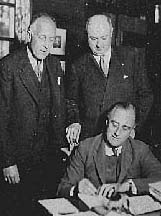 |
| FDR signs the Emergency Relief Act, as FVZA Directors Louis Huffman (r) and Anton Bowers look on. |
Central to the dilemma facing lawmakers was the question, what exactly were vampires and zombies? Were they merely human beings with diseases? And if so, didn't they deserve hospitalization and rehabilitation? After refusing to rule on the issue for a number of years, the Supreme Court finally agreed in 1935 to hear the case of a New Jersey couple whose son had turned into a vampire and was destroyed by FVZA agents. In a 5-4 vote, the Court deemed that vampirism was a disease and that vampires were entitled to the same rights as any U.S. citizen. Shortly thereafter, the Court issued a similar ruling on the issue of zombieism. An avalanche of lawsuits followed, crippling the FVZA.
Fortunately, recently-elected President Franklin Delano Roosevelt understood the importance of the FVZA. The President was dealing with a depression at home and a world on the brink of war and knew he could not afford to have vampire and zombie outbreaks added to the mix. In December of 1936, Roosevelt brought FVZA leaders to Warm Springs, Arkansas, to hammer out an arrangement by which the Agency could continue to function. The resultant plan, known as the Emergency Relief Act, brought major changes to the FVZA. The Agency would henceforth operate undercover so as not to attract public attention. A new communication pipeline was set up that allowed law enforcement agencies to pass reports of vampire and zombie activity on to Agents. The FVZA moved its operations into nondescript buildings and discontinued its policy of notifying the families of exterminated vampires and zombies. Those exterminated simply joined the rolls of the missing. To facilitate the FVZA's shift to deep cover, the government began a systematic removal of the Agency from public records.
The new system was very much a work in progress and didn't always function perfectly, but over time the FVZA adapted so well to its undercover role that, for many, the Agency became nothing more than an "urban legend."
The irony of the Emergency Relief Act is that the U.S. government ultimately exploited it in order to conduct research on vampire and zombie DNA in secret. To this day, many in the government deny such research is taking place. How can there be such research, they ask, if there never were vampires or zombies to begin with? When asked once about whether he supported construction of an FVZA memorial in Washington, Senator Trent Lott scoffed, "sure, we can put it right next to the one for Santa Claus!" (Editor's note: Mr. Lott represents Mississippi, a state where over 100 FVZA Agents lost their lives fighting the undead).