

Ask Dr. Pecos
Archives
Q: You have a severely warped conception of vampires. We aren't all bad...I know some of us are cruel and have done some horrible things, but there are some in every bunch...you don't see me out there hunting and killing mankind...have you ever thought about getting a vampire's side of the story?
Anonymous

Vampire control has always been complicated by civilians who insist on romanticizing them. One reason I fear that a new vampire outbreak would spread quickly in today's world is that so many people would protect vampires and even willingly join their ranks. As an example, I point to a club called "Fang" that opened recently in Albuquerque not two miles from the former site of the FVZA Academy. The patrons at Fang make themselves up to resemble vampires, drink blood-red martinis and listen to nihilistic music. These types of establishments are popping up all over the place. It is appalling to me that people choose to celebrate vampirism. Sometimes I think it will take nothing less than another plague to show people the folly of their ways.
Q: What kind of agencies did other countries have to control vampires and zombies?
Nigel, Brisbane, Queensland, Australia
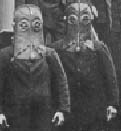
sporting primitive
vampire protection
circa 1861
Q: Is it possible to be infected with the zombie and vampire viruses simultaneously?
Brent, Edmonton, Alberta, Canada

zombie
Q: Is there any truth to the vampire "slayer" legend? Marc W., Kelowna, B.C., Canada
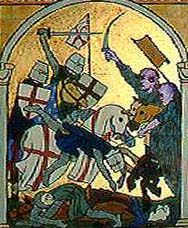
in battle with vampires
After the Vampire Crusades were over, the slayers lived on in the form of medieval Slayer Guilds, which were organizations of men trained in art of fighting vampires. Since this trade, like others of that time, was passed on from father to son, there grew a notion of certain people being inherently endowed with vampire-fighting capability. This notion persists in the modern world. The chief flaw with the slayer legend in its modern incarnation is that, when it comes to fighting vampires, training and experience are far more important than any inherent ability one might possess.
Q: How do you kill vampires and zombies?
Pedro, San Diego, California
A: More misinformation surrounds this question than perhaps any other dealing with the undead. While there are a number of ways to kill vampires and zombies, each one carries with it considerable risk and none should be attempted without sufficient training. Here is a partial list of ways to kill vampires and zombies, along with the advantages and disadvantages to each method.
Conclusion: if it's vampires you want to kill, my advice is to study marksmanship, buy a high-powered rifle with explosive bullets and a good night vision scope, and set yourself up in a protected spot with a 360-degree vantage. And keep a flamethrower and a stash of hand grenades around, just in case. For zombies, the best thing to do is get in your car and drive to a place where there are no zombies. If that's not an option, then strap on a flamethrower, surround your property with explosive devices, and wait.
Q: Do vampires and zombies get colds, flu, cancer, and all the other sicknesses and diseases human beings get?
Darren, Wakefield, Massachusetts
A: Unfortunately, vampires are the very model of good health. They have low cholesterol and blood pressure and no heart disease. There has never been a reported case of a vampire having cancer. In fact, vampires who had cancer when they were bitten lose all trace of the disease within a few months after transformation. Very rarely are vampires sick, although the chemical imbalances in their brains could be called a kind of mental illness. As for zombies, colds are the least of their problems. Beset by parasitic organisms, zombies suffer from gangrene, tapeworms and caseation (the degeneration of bodily tissue into a cheese-like substance), among other things.
Q: During a recent visit to a health foods store, I was shocked to discover a skin cream called "Eternal Youth" that claimed to contain some kind of vampire by-product. What is this, and should we be alarmed?
Brenda, Bozeman, Montana
A: Eternal Youth products were developed in 1998 by John Purcell, a Canadian biochemist. Purcell heated vampire blood in order to kill the virus, then separated out and freeze-dried the blood serum.

Q: Can vampires survive by drinking the blood of other vampires?
Heather, Wiscasset, Maine
A: In a word, no. While there is anecdotal evidence that drinking the blood of another vampire will temporarily sate a vampire's bloodlust, vampire blood does not supply all of the proteins necessary for their survival. They must drink the blood of humans, or die. Ultimately, it is this simple equation that drives a vampire's powerful survival instinct.
In 1928, the Goessman Institute in Switzerland conducted the most exhaustive study yet of vampires. As part of the study, a total of 20 vampires were restricted to a diet of vampire blood. The vampires became lethargic and disoriented after only three days. Within 10 days, all 20 vampires were dead.